IIoT with AI - PPE Monitoring at the Edge
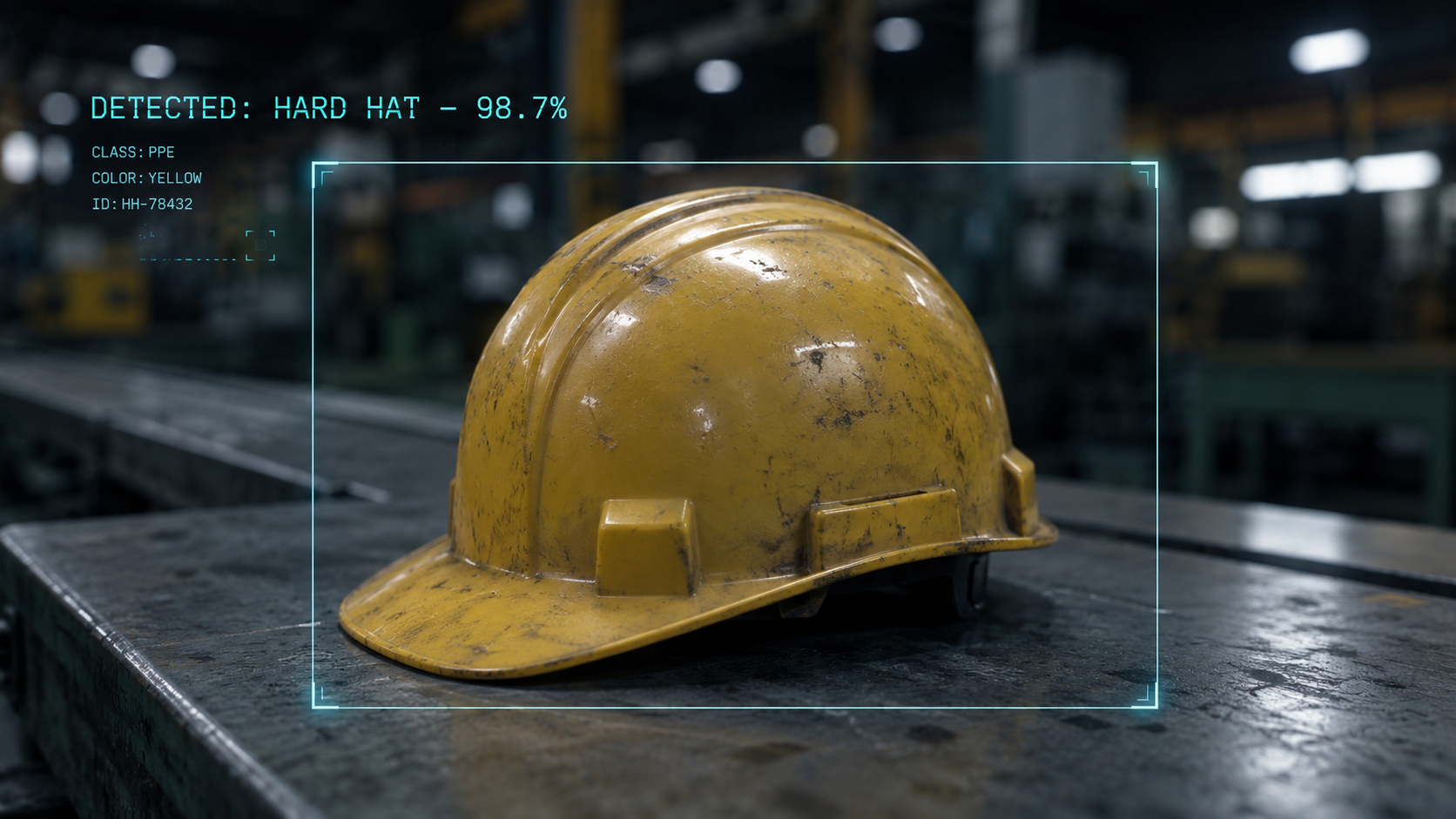
PPE Monitoring at the Edge
An opinionated reference architecture for IIoT-based worker safety compliance.
A single OSHA citation for head protection violations runs into five figures. A fatality investigation costs orders of magnitude more, and that’s before insurance premiums spike and your safety record becomes a procurement liability. Meanwhile, the dominant model for catching PPE violations — manual safety audits — samples a sliver of work hours and lags the actual incident by hours or days. The economic case for automated PPE monitoring has been settled for years.
Yet most PPE monitoring deployments underperform or quietly die in pilot. The reason is not that the computer vision is hard. YOLO variants have been adequate for hard-hat detection since 2020. The reason is that architects treat PPE monitoring as a computer vision problem when it is actually a distributed systems problem. The ML is the easy part. The integration, the operational loop, the privacy posture, and the failure modes are where deployments live or die.
This blog is a reference architecture written for IIoT architects who are tired of vendor decks and want defensible technical positions. It is strongly opinionated by design. Where reasonable people disagree, I will say so. Where I think a common practice is wrong, I will say that too.
What this blog does not cover: model training internals, vendor procurement, or jurisdiction-specific regulatory analysis. Those deserve their own treatments.
The Use Case, Defined Precisely
Architects need constraints, not vibes. Here are the parameters this architecture is designed against.
Detection targets. Hard hats, high-visibility vests, and safety glasses are tractable with modern vision models. Gloves are notoriously hard — small, occluded, and visually similar to bare hands at distance. Steel-toed boots are effectively impossible from overhead or angled mounts and should not be attempted with vision alone. Be honest with stakeholders about what is and is not detectable; promising glove detection on a fixed-camera deployment is how you lose credibility in month three.
Zones. Three patterns cover most facilities. Entry gates are high-stakes and low-throughput — the place to enforce gate-and-alert with strict latency budgets. Active work areas need continuous monitoring with aggregate-and-report semantics. Restricted zones combine presence detection with PPE compliance and typically carry the highest false-positive cost because they trigger physical responses.
Latency budgets. Entry gates need decisions in 2–5 seconds (fast enough to flag a worker before they’re 20 feet down the corridor). Area monitoring tolerates 30-second windows. Anyone insisting on sub-second latency for general PPE monitoring has not thought about the actual operational response time.
Accuracy targets. Recall matters more than precision for safety — a missed violation is worse than a false alarm. But false-alarm fatigue is the single fastest way to kill a deployment, so precision is not optional. Target greater than 95% recall and greater than 85% precision as defensible starting points, then tune based on operational feedback. Anyone quoting “99% accuracy” without specifying the metric is selling something.
Privacy and regulatory constraints. GDPR in Europe, BIPA in Illinois, works council requirements across the EU, and an emerging patchwork of state biometric laws in the US. This is not a compliance checkbox you bolt on at the end. It shapes whether you can store frames, for how long, whether facial features must be blurred at the edge, and whether the system can identify individuals at all. Have this conversation before you write any code. I have seen six-figure deployments mothballed because a works council objected in week eleven.
Scale. This architecture assumes 50–200 cameras across a single facility. Multi-site federation is a footnote; the principles extend cleanly but the operational story changes.
Non-negotiables. Low latency at gates. No facial recognition (period). Store-and-forward resilience for network partitions. Auditable decisions for every alert that reaches a human.
The Reference Architecture
The data path runs: camera → edge inference → local buffering → MQTT broker → cloud ingest → split storage (telemetry, events, evidence) → analytics and human review → retraining loop. Each layer carries an architectural decision, and I’ll take a stance at every one.
Capture layer
Use industrial PoE cameras. Axis, Hanwha, and Bosch are the credible vendors. ONVIF compliance, optical quality at distance, and field-tested reliability matter more than the spec sheet differences between models. Consumer IP cameras have no place in a production safety system — they will fail in ways that are hard to diagnose, and they will fail at the worst time.
A specific stance worth defending: in regulated markets (US federal, EU public sector, most defense-adjacent supply chains), avoid Hikvision and Dahua for new deployments. The technology is competitive on price and capability, but procurement restrictions and supply-chain scrutiny make them a liability over a five-year deployment horizon. In unregulated markets the calculus differs.
Do not reuse existing CCTV infrastructure for ML. This is the single highest-leverage opinion in this blog. Existing CCTV is mounted for human review, which means wide fields of view, oblique angles, and codecs optimized for human perception rather than model input. PPE objects end up small, motion-blurred, or occluded at exactly the angles ML models struggle with. The temptation to reuse infrastructure is the number one reason POCs underperform and the number two reason production deployments quietly degrade. Spend the capex on properly mounted, ML-purposed cameras at the zones that matter.
Lighting and placement contribute more to accuracy than model architecture. A mediocre detector with good lighting and a clean mounting angle will outperform a state-of-the-art detector fighting backlight and occlusion. If your accuracy is poor, fix the physical layer before retraining the model.
Edge compute
Inference belongs at the edge, full stop. Cloud inference for PPE is an anti-pattern: bandwidth costs scale linearly with cameras and frame rates, latency budgets get blown by network variance, and shipping video frames to a cloud region creates privacy exposure that is genuinely hard to defend in a works-council meeting. The math, the latency, and the privacy posture all push the same direction.
Hardware: NVIDIA Jetson Orin Nano is the default. At roughly $249 for the dev kit and 40 TOPS of inference capacity, it handles a realistic camera fan-out (4–8 cameras at 2–5 FPS depending on resolution) with headroom. The ecosystem — JetPack, TensorRT, DeepStream — is mature enough that you spend your engineering time on the application, not on toolchain debugging.
Coral TPU is the credible second choice if you’re cost-sensitive and willing to commit to TFLite. Coral advocates will argue for the cost-per-inference numbers; the counter-argument is that Jetson’s flexibility wins over a three-year deployment horizon where you will want to update models, change architectures, or add adjacent workloads.
Raspberry Pi plus USB accelerator is fine for POCs. It is not a production platform. The failure modes — SD card corruption, thermal throttling, USB flakiness — are well-known and will bite you in the field.
One edge node per 4–8 cameras is a reasonable planning ratio. Higher resolution or higher frame rate workloads pull that ratio down toward 4; lower-resolution gate cameras push it toward 8.
The ML pipeline
Use YOLOv8-s or YOLOv8-m, fine-tuned on PPE data. YOLOv8 has better small-object performance than MobileNet-SSD, more deployment tooling than DETR variants, and easier quantization paths than transformer-based detectors. Worth acknowledging: RT-DETR is the credible challenger as of 2025 — it closes the accuracy gap and is improving fast. If you’re starting fresh today, benchmark both. If you need to ship in a quarter, YOLOv8 wins on deployment maturity.
Use a two-stage pipeline: person detection first, then PPE classification on the cropped person regions. Single-shot multi-class detectors work, but they are harder to debug (“why did it miss the helmet on this worker but not that one?”) and harder to retrain incrementally when you add a new PPE class. The two-stage approach also lets you swap the PPE classifier independently of the person detector, which matters more than you’d think over a multi-year deployment.
Deploy with ONNX Runtime as the default. TensorRT if you’re all-NVIDIA and need the last 30% of performance and you have someone on the team who enjoys the optimization rabbit hole. TFLite only if you’ve committed to Coral. PyTorch in production at the edge is a mistake people keep making — it works in development, it works in your POC, and it slowly poisons your operational story as you accumulate dependencies and version drift. Ship ONNX.
On frame rate: 2–5 FPS is sufficient for PPE detection. State changes — putting on or removing a hard hat — happen on human timescales. Anyone running 30 FPS inference for PPE is wasting compute and burning power for no operational benefit.
Communication and the messaging spine
MQTT for events. gRPC for image evidence. OPC-UA only if you’re integrating with PLCs to physically gate doors or stop equipment. Mixing these up is the most common protocol mistake I see. Do not stream video frames over MQTT. Do not use OPC-UA as a general-purpose message bus.
Use Sparkplug B as your MQTT payload specification. It gives you birth and death certificates, state management, and the closest thing IIoT has to a real standard. Plain MQTT plus ad-hoc JSON payloads is more common in the wild, but you will reinvent half of Sparkplug B in your first year and the other half in your second. Adopt the standard and move on.
A single MQTT broker (HiveMQ or EMQX for production, Mosquitto for development) sits between edge and cloud. Edge nodes publish events; cloud services subscribe. The broker handles the network-partition reality of industrial environments — edge nodes queue events locally and flush when connectivity returns.
The data layer
This is where opinions diverge most sharply, so I’ll be explicit. Use InfluxDB plus PostgreSQL plus S3 or MinIO as your default stack. Each store handles what it’s good at:
InfluxDB holds high-frequency telemetry: camera health, inference latency, queue depths, per-zone throughput counts. The ingest model fits sensor data, the Telegraf agent ecosystem cuts integration time substantially, and Flux (or InfluxQL) handles the time-window queries you actually run on operational data.
PostgreSQL holds entities and events: workers (anonymized identifiers, never faces), contractors, zones, sites, shifts, and the violation events themselves. Time-series databases are bad at the relational queries safety officers actually ask — “show me all violations by contractor X across all sites in Q3 broken down by violation type.” Forcing those queries into a TSDB because it is the “IIoT database” is how teams end up writing application-layer joins in Python and wondering why their dashboards are slow.
Object storage holds image evidence with strict lifecycle policies. Thirty days hot, then cold storage or deletion depending on jurisdiction. Image evidence in your primary database is an anti-pattern.
TimescaleDB is the credible alternative to this split. If your team is SQL-heavy and the operational cost of running two databases outweighs the ergonomic wins of a specialized TSDB, TimescaleDB + S3 is a defensible architecture. Pick the smaller stack if your team is small.
What you should not do: put everything in InfluxDB because a vendor whitepaper called it the IIoT database. The marketing language is not load-bearing.
Analytics and the human loop
Ops dashboards and compliance dashboards are different products for different audiences. Do not merge them. Grafana fronting InfluxDB handles ops — camera uptime, inference latency, alert volumes, throughput. Safety officers do not care about p99 inference latency. They care about violation trends by zone and by shift, and they want a workflow for reviewing flagged frames, marking false positives, and exporting compliance reports. Build that as a separate application (Superset works; a custom React app on Postgres works better) with the right vocabulary and the right workflow.
The retraining loop is where most deployments quietly fail. Models drift. Winter jackets break vest detection. New contractors show up in unusual PPE colors. The reflective-tape pattern on this season’s vests differs from last season’s training data. If your architecture does not include a flagged-frame review queue, a human labeling workflow, and a weekly or biweekly model update cadence, you are building a system that will silently degrade over its first eighteen months and lose stakeholder trust right when it should be proving its value. Budget for labeling from day one. It is the single most underestimated line item.
Alert aggregation and escalation tiers are mandatory. A raw stream of every detected violation is not an alert system — it is a denial-of-service attack on your safety officers. Group violations by worker session, prioritize by zone severity, escalate based on duration or repetition, and route to the right human at the right time. The fastest way to kill a deployment is to flood the inbox in week one.
Using open datasets pragmatically
CHV (Color Helmet and Vest), Pictor-PPE, and SH17 are the open datasets worth knowing. Use them for pretraining and augmentation. They will get you from cold start to a workable initial model faster than collecting your own data.
They are biased toward construction sites, daylight conditions, and Western workforces. Your facility — whether it is a chemical plant in Gujarat, a logistics warehouse in Ohio, or a steel mill in Germany — will look different. Never use open datasets as your validation set. Hold out your own labeled facility data for validation, always. The number on the public dataset is a vanity metric; the number on your facility data is the one that matters.
The Decisions That Will Burn You
Some choices have consequences that only show up at month six or year two. Here are the ones worth getting right up front.
Edge versus cloud inference. Run the math: 100 cameras at 5 FPS at 1080p produces roughly 50–100 GB/hour of video data per facility. Shipping that to a cloud region for inference, twenty-four hours a day, three hundred sixty-five days a year, across a three-year deployment, is a six-figure bandwidth bill before you have inferred anything. Edge inference flips that into a one-time hardware cost. The edge math wins every time outside of pathological cases (very few cameras, very expensive edge hardware constraints).
Build versus buy the model. Buy if a vendor has a verified model card for your specific PPE set, your lighting conditions, and your workforce demographics. Build if you have unusual PPE or in-house labeling capacity. Avoid the middle path — buying a generic vendor model and tuning it yourself — which inherits the disadvantages of both: vendor lock-in on the runtime, plus your own labeling and retraining burden. The hybrid is the worst of both worlds in my experience.
Framework choice at the edge. ONNX Runtime as default. TensorRT for all-NVIDIA performance work. TFLite for Coral commitments. PyTorch is a development framework, not a production runtime. This is not a religious position; it is an operational one.
Database choice. The InfluxDB + Postgres + S3 split costs more to operate than a single-database stack. The query patterns justify it for deployments over roughly fifty cameras. Below that, TimescaleDB + S3 is fine. Above that, the split pays for itself the first time a regulator asks for a contractor-level audit report.
A rough cost illustration for a hundred-camera deployment over three years: hardware (cameras at ~\(800 each, fifteen Jetson nodes at ~\)400 each fully kitted, networking and switches) lands around \(100K; software is effectively \)0 with open source plus an enterprise support contract if you want one (\(20–50K/year); labeling — and this is where teams under-budget — runs \)30–60K depending on how much in-house capacity you have; ongoing ops including model retraining and infrastructure runs another \(50–80K/year. The total three-year TCO lands in the \)300–500K range for a serious deployment. Vendor SaaS pricing for the same scope routinely quotes higher and locks you in. Architects will photocopy this paragraph.
Gotchas Nobody Warns You About
A few realities that the vendor decks omit.
Seasonal model drift is real. Winter jackets, rain gear, and high-visibility outerwear all break vest detection trained on summer data. Plan for two retraining cycles per year minimum, more if your facility has dramatic seasonal variation.
Cardinality explosion in InfluxDB. Tag your measurements by camera_id × zone × shift × worker_role and you will discover the hard way that InfluxDB’s performance is sensitive to tag cardinality. Keep high-cardinality data (anything per-worker, per-event) out of TSDB tags. This is one of the reasons the database split matters.
Network partitions are not edge cases. Industrial networks drop, switches reboot, fiber gets cut. Your edge nodes need store-and-forward queuing with bounded local storage and a clear policy for what happens when the queue fills. “We’ll add that later” means you ship a system that loses data the first time the WAN hiccups.
Adversarial workers exist. Some workers will try to game the system — holding a hard hat in front of the camera rather than wearing it, tilting their head to occlude the vest, walking through zones in groups to confuse the tracker. Most of this is solvable with better camera placement and short-window temporal logic (“hard hat must be present for N consecutive frames within a Y-second window”). Pretending it does not happen is the only failure mode that is not solvable.
The privacy conversation is a design constraint. I said this earlier; I am repeating it because it is the single most ignored architectural input. Start the works-council and legal conversations in the discovery phase, not after the demo. Bake the constraints — no faces stored, on-edge blurring, evidence retention policies, individual identification prohibitions — into the architecture from day one.
Alert fatigue kills deployments faster than bad models. A 90% accurate model with smart aggregation will outperform a 99% accurate model with raw alerting in actual operational adoption. Get the human-loop design right and the model quality matters less than you think.
A Starter Stack You Can Build in Two Weeks
The full reference architecture is what you grow into. To prove out the approach, build this:
Two Axis or Hanwha PoE cameras at one entry gate. One NVIDIA Jetson Orin Nano running YOLOv8-s fine-tuned on CHV plus 500 of your own labeled frames, deployed via ONNX Runtime. Mosquitto as your MQTT broker with Sparkplug B payloads. InfluxDB OSS for telemetry, PostgreSQL for events, MinIO for image evidence, all in Docker Compose on a single cloud VM or on-prem server. Grafana on InfluxDB for ops, a simple React app on Postgres for the safety officer view.
This gets you a defensible POC in about two weeks of focused work. Every component scales to production without re-architecting. Every component is open source. The total bill of materials for the prototype sits under $5K.
The technology to do this well has been ready for three years. The architectures haven’t caught up. That gap — between what the tools can do and how teams actually deploy them — is where the next wave of operational improvement in industrial safety is going to come from. The teams that get the distributed-systems story right, not the ones with the fanciest models, will define what production-grade PPE monitoring looks like for the next decade.